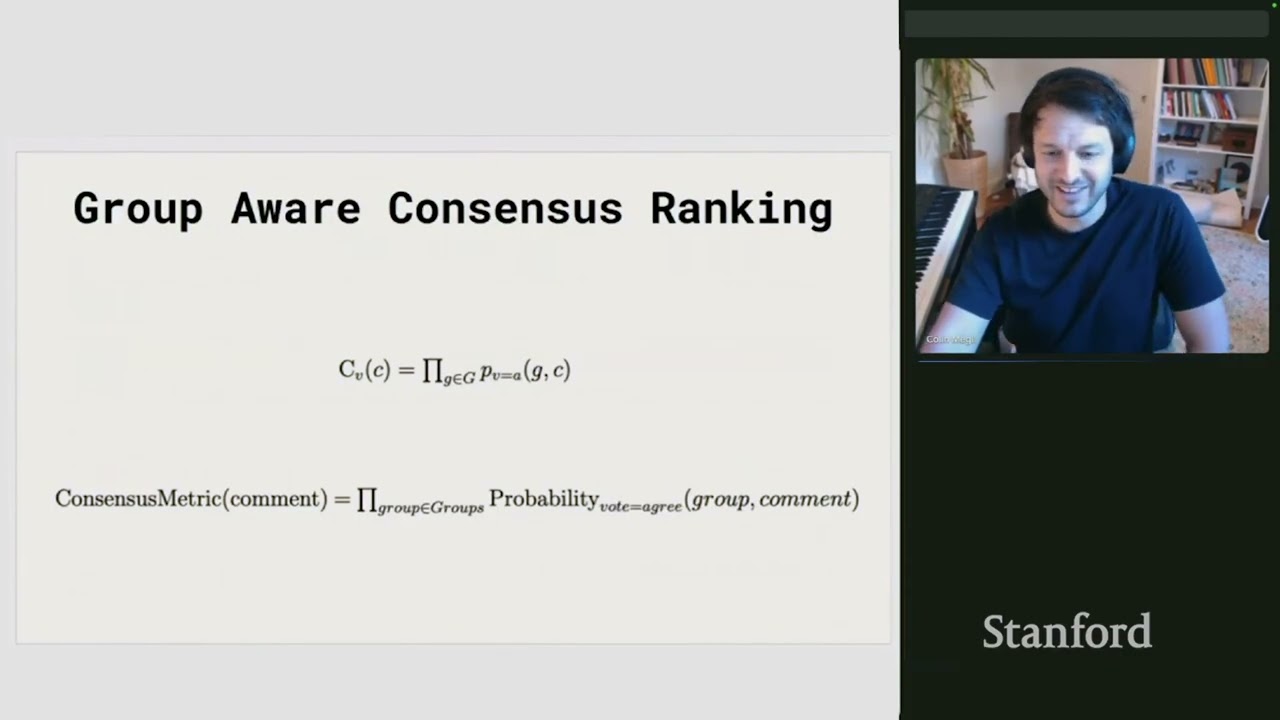
Stanford CS329H: Machine Learning from Human Preferences | Autumn 2024 | Voting
BeginnerKey Summary
- •This lecture kicks off an Introduction to Machine Learning course by explaining how the class will run and what you will learn. The instructor, Byron Wallace, introduces the TAs (Max and Zohair), office hours, and where to find all materials (Piazza/Canvas). The course has weekly graded homework, a midterm, and a group final project with a proposal, report, and presentation. Lectures are mostly theory and recorded; hands-on coding happens in homework.
- •There are no strict prerequisites, but you should be comfortable with Python, and have basic linear algebra and calculus. Review resources are posted for anyone who needs a refresher. Collaboration on homework is allowed in fixed groups of up to three, but each student must submit their own write-up. Academic integrity expectations are stressed: learn by doing your own work and do not post solutions publicly.
- •The curriculum is organized into modules: supervised learning (starting with linear models), then non-linear models (decision trees, random forests, neural networks), then unsupervised learning (clustering and dimensionality reduction), and finally probabilistic machine learning (Bayesian inference, graphical models, and Markov chain Monte Carlo). Each module includes readings, lectures, and a matching homework. Supervised learning is introduced with the core idea of learning a mapping from inputs (features) to outputs (targets). Realistic examples include cat/dog image classification, spam detection, house price prediction, and medical risk prediction.
- •Two main supervised learning task types are explained: classification (predict categories like 'spam' or 'not spam') and regression (predict continuous values like house price). Linear models are presented as simple, interpretable baselines for both tasks. You learn that model parameters (coefficients) describe how each input feature contributes to the prediction. Training means choosing parameters that minimize the difference between predictions and actual targets.
- •Feature engineering is emphasized as a crucial step to improve model performance. Instead of using raw inputs like latitude and longitude, better features like 'distance to city center' or 'neighborhood average income' can be created. Good features help even simple models work well and can reduce the need for very complex models. The lecture provides concrete examples of useful engineered features.
- •Non-linear models such as decision trees, random forests, and neural networks are previewed. They capture more complex relationships by using non-linear functions, allowing better performance when linear assumptions are too simple. You’ll still rely on the same supervised learning framework of inputs and targets. These models trade some interpretability for flexibility.
- •Unsupervised learning is introduced as finding structure in unlabeled data. Clustering groups similar data points without predefined labels. Dimensionality reduction compresses high-dimensional data so it’s easier to visualize and work with. These methods are helpful for exploration, preprocessing, and discovering hidden patterns.
- •Probabilistic machine learning brings uncertainty into the picture. Bayesian inference, graphical models, and Markov chain Monte Carlo are named as key techniques. They help when data is limited or when you want to incorporate prior knowledge. These tools provide a principled way to quantify confidence in predictions.
- •The grading scheme is clear: homework 50%, midterm 20%, final project 30%. The midterm is in person, with sample past exams shared for practice. Homework is due Wednesdays at 11:59 PM Eastern, and collaboration rules are fixed once groups are set. The final project mirrors homework groups and pushes you to explore a topic of your choice deeply.
- •The instructor highlights real-world applications in medicine and public health, like predicting heart attack risk from patient data and evaluating effects of interventions. These examples show why careful modeling and understanding of uncertainty matter. You see how supervised learning can support decision-making in sensitive domains. The course encourages thinking about causality and careful data interpretation.
- •Lectures are primarily conceptual and theoretical; coding practice happens in the assignments. Recordings will be posted soon after class. Piazza is the central hub for updates, resources, and Q&A. The TAs are available to help you stay on track and understand both theory and practice.
- •By the end of the lecture, you understand the roadmap: start with linear models and feature engineering, then expand to non-linear methods, then explore unsupervised learning, and finish with probabilistic approaches. You know the expectations and how to prepare (Python, math reviews). You also understand the problem types (classification and regression) and the role of model parameters and training. The stage is set for the next lecture on algorithms for training linear models.
Why This Lecture Matters
This lecture matters because it gives you a practical roadmap for learning machine learning the right way: start with solid foundations, use interpretable baselines, and build up to more complex ideas only when needed. For students, analysts, and aspiring data scientists, the structure—weekly practice, clear grading, collaborative but accountable homework, and a deep final project—ensures steady progress. In real work, you constantly face questions like “Is this problem classification or regression?” and “Are my features telling the right story?” The lecture’s emphasis on supervised learning, linear models, and feature engineering directly answers these, showing how to design clean, reliable solutions. Professionals in domains like healthcare, public policy, and business benefit from the focus on uncertainty and interpretability. Predicting heart attack risk or evaluating interventions requires both accurate models and honest confidence about predictions, which the course eventually addresses with probabilistic methods. The approach also strengthens your career development: employers value people who start with clear baselines, engineer meaningful features, evaluate properly, and communicate results lucidly. In today’s industry—where ML is everywhere from recommendation systems to risk assessment—knowing when to use a simple linear model and when to scale up to non-linear or probabilistic tools is a critical, differentiating skill. This lecture sets you up to make those calls confidently and responsibly.
Lecture Summary
Tap terms for definitions01Overview
This first lecture launches an Introduction to Machine Learning course and sets expectations for both the logistics and the learning journey. The instructor, Byron Wallace (Khoury College of Computer Sciences), begins by introducing himself and the teaching assistants, Max and Zohair, who will host office hours and help with assignments. Students are directed to Piazza (linked from Canvas) as the single source of truth for announcements, lecture notes, assignments, and recordings. The class will meet in person, and recordings will be posted shortly after each lecture. Graded components include weekly homework (50%), an in-person midterm (20%), and a final project (30%), which is done in the same groups as the homework and includes a mid-semester proposal, a final report, and a presentation.
There are no rigid prerequisites, but students are expected to have basic programming skills, especially in Python, and to be comfortable with linear algebra and calculus. Review materials are provided for those who feel rusty. Collaboration is allowed in groups of up to three for homework, but each student must write up and submit their own solutions, encouraging real learning rather than copying. Academic integrity is highlighted: you may look online for ideas, but you must implement your own solutions and never post course solutions publicly.
Pedagogically, the course is organized into modules, each focusing on a family of algorithms and paired with readings, lectures, and an assignment. The first module covers supervised learning, starting with linear models. Here, you learn the core supervised learning setup: input features (also known as predictors, independent variables, or covariates) and targets (also known as outcomes, dependent variables, or responses). The goal is to learn a function that maps inputs to outputs. Two key supervised problem types are defined: classification (predicting categories, like spam vs. not spam or animal types) and regression (predicting continuous values, like house price or tomorrow’s temperature).
Within this framework, linear models are positioned as simple, interpretable, and surprisingly powerful. A linear model assumes the target is a weighted sum of the input features plus an intercept. The house price example illustrates this with terms like square footage, location, and number of bedrooms. Learning means finding parameter values (weights/coefficients) that minimize the difference between predicted and actual targets on training data. Linear models can be used for both classification and regression and are foundational building blocks for more complex methods.
Feature engineering is introduced as a crucial practice for improving model performance. Instead of feeding raw inputs like latitude and longitude directly into a model, you might create more informative features such as distance to a city center or neighborhood average income. These engineered features can make patterns more obvious to the model, increasing accuracy and reducing the need for highly complex architectures. The importance of thoughtful feature creation and transformation is emphasized because it often has a larger impact on performance than changing algorithms.
After linear models, the course broadens to non-linear models such as decision trees, random forests, and neural networks. While these still operate within the supervised learning paradigm (mapping inputs to outputs using labeled data), they use non-linear functions, which allows them to represent more complex relationships in the data. Next, the course turns to unsupervised learning, which finds structure in unlabeled data through techniques like clustering (grouping similar points) and dimensionality reduction (compressing data for easier visualization and preprocessing). Finally, the course covers probabilistic machine learning, including Bayesian inference, graphical models, and Markov chain Monte Carlo (MCMC). These methods explicitly represent uncertainty and are especially helpful when data is scarce or when you want to incorporate prior knowledge.
Throughout, the instructor references real-world applications, particularly in medicine and public health, such as predicting heart attack risk or understanding the effects of clinical interventions. This grounds the theory in meaningful problems and motivates careful modeling choices. The lecture closes by previewing the next steps: delving into specific training algorithms for linear models in the following session. By the end of the lecture, students know how the class runs, what topics they will learn, and the key concepts of supervised learning, classification vs. regression, linear models, and feature engineering.
02Key Concepts
- 01
Course Hub and Logistics: 🎯 The course uses Piazza (linked from Canvas) as the central place for announcements, notes, and assignments. 🏠 Think of Piazza like a classroom bulletin board that is always up-to-date and open 24/7. 🔧 All materials, including lecture recordings, will be posted there so you don’t miss anything. 💡 Without a single hub, students can get confused about due dates and resources. 📝 Check Piazza regularly to stay current on homework deadlines and exam details.
- 02
Team and Support: 🎯 The instructor is Byron Wallace, supported by TAs Max and Zohair who hold office hours. 🏠 This is like having a coach and assistant coaches who can help when practice gets tricky. 🔧 TAs answer questions on theory and code, guide you through assignments, and clarify concepts. 💡 Without timely help, small confusions pile up and slow your progress. 📝 Use office hours early, not just before deadlines.
- 03
Grading and Deadlines: 🎯 Homework is 50%, the midterm is 20%, and the final project is 30%, with homework due Wednesdays at 11:59 PM Eastern. 🏠 Picture this like a game where weekly practice (homework) matters most, but the big matches (midterm and project) also count. 🔧 Clear weights help you prioritize time and effort. 💡 If you ignore homework, your grade and learning both suffer. 📝 Plan your week so you’re not rushing right before the Wednesday cutoff.
- 04
Collaboration Policy: 🎯 You can work in groups of up to three for homework but must submit your own write-up. 🏠 This is like studying together but taking your own test. 🔧 Fixed groups promote accountability and steady teamwork throughout the semester. 💡 Copying without writing your own solutions prevents real understanding and is an integrity violation. 📝 Form your group early and divide tasks fairly while ensuring everyone can explain the full solution.
- 05
Academic Integrity: 🎯 You must implement your own solutions and never post homework answers publicly. 🏠 Imagine a puzzle challenge where the point is to solve it yourself, not just see the final picture. 🔧 You may look online for concepts, but direct copy-paste defeats the learning goal. 💡 Sharing solutions hurts future students and can trigger serious consequences. 📝 Use outside resources to learn ideas, then close them and write your own code and explanations.
- 06
Course Structure by Modules: 🎯 The course is divided into modules, each covering a family of algorithms plus readings, lectures, and a matching homework. 🏠 It’s like learning in themed chapters with an exercise set after each. 🔧 This structure keeps learning focused and cumulative. 💡 Without structure, topics can feel random and hard to connect. 📝 Expect a rhythm: learn core ideas in lecture, then solidify them in homework.
- 07
Supervised Learning – Big Picture: 🎯 Supervised learning learns a function that maps inputs (features) to outputs (targets) using labeled examples. 🏠 It’s like learning to recognize fruit by seeing many labeled pictures (apples, bananas, etc.). 🔧 You feed the model pairs of (x, y) so it can find patterns to predict y from x. 💡 Without labeled data, the model wouldn’t know what correct answers look like. 📝 Examples include classifying emails as spam or not, or predicting a house’s price.
- 08
Classification Tasks: 🎯 Classification predicts categories such as spam/not-spam or animal types. 🏠 It’s like sorting mail into different bins. 🔧 The model outputs class labels (or probabilities for each class) based on learned patterns. 💡 Treating a category like a number would mislead a model that assumes continuity. 📝 Cat vs. dog image classification is a classic classification example.
- 09
Regression Tasks: 🎯 Regression predicts continuous values like house price or temperature. 🏠 It’s like estimating someone’s height from their age and parents’ heights. 🔧 The model outputs a real number, trying to be close to the true value. 💡 If you force categories for something continuous, you lose precision and accuracy. 📝 Predicting home prices with features like size, location, and bedrooms is a common regression problem.
- 10
Linear Models – Core Idea: 🎯 A linear model assumes the target is a weighted sum of features plus an intercept. 🏠 It’s like mixing ingredients (features) in set proportions (weights) to make a recipe (prediction). 🔧 Each coefficient shows how much that feature pushes the prediction up or down. 💡 Without a simple baseline, you can’t judge whether complex models are truly needed. 📝 House price = β0 + β1×square footage + β2×location + β3×bedrooms is a linear model.
- 11
Model Parameters (Coefficients): 🎯 Parameters are the numbers (weights) the model learns to best fit the data. 🏠 Think of them like the volume knobs on different music tracks you adjust to make the song sound right. 🔧 Training finds parameter values that minimize prediction error on the training data. 💡 If parameters are random or poorly chosen, predictions will be consistently wrong. 📝 A positive weight on square footage means larger homes predict higher prices, all else equal.
- 12
Training Objective: 🎯 Training means picking parameters that make predictions close to true targets. 🏠 Like practicing free throws to reduce your misses over time. 🔧 We measure closeness with a loss function and adjust parameters to reduce it. 💡 Without a goal (loss) to minimize, the model has no direction for improvement. 📝 In regression, a common loss is the squared difference between predicted and true prices.
- 13
Feature Engineering: 🎯 Feature engineering creates better input features to improve model performance. 🏠 It’s like turning a blurry picture into a sharper one before handing it to a friend to identify. 🔧 You can transform raw inputs (like latitude/longitude) into more meaningful ones (distance to city center). 💡 Poor features can hide patterns and make even good algorithms perform badly. 📝 Adding neighborhood average income can help predict house prices more accurately than raw coordinates.
- 14
Non-linear Models: 🎯 Non-linear models (decision trees, random forests, neural networks) can learn complex relationships. 🏠 They’re like flexible tools that can bend and twist to fit curves, not just straight lines. 🔧 They use non-linear functions or structures to capture interactions and thresholds. 💡 When data patterns aren’t straight-line-ish, linear models may miss important signals. 📝 A decision tree can split on different feature thresholds to carve the space into meaningful regions.
- 15
Unsupervised Learning: 🎯 Unsupervised learning finds structure in unlabeled data. 🏠 It’s like sorting a box of mixed Lego pieces into groups without any labels. 🔧 Methods like clustering group similar points; dimensionality reduction makes data easier to visualize. 💡 Without labels, you still need ways to explore and understand the data. 📝 Clustering customers by behavior can reveal natural segments for marketing.
- 16
Probabilistic Machine Learning: 🎯 Probabilistic ML models uncertainty using tools like Bayesian inference, graphical models, and MCMC. 🏠 It’s like saying, “I’m 70% sure it will rain,” not just “rain or not.” 🔧 These methods combine prior beliefs with data and provide distributions instead of single guesses. 💡 Knowing uncertainty helps in high-stakes decisions, especially with limited data. 📝 In medicine, reporting risk with confidence intervals is crucial for care decisions.
- 17
Real-World Applications in Health: 🎯 ML can predict outcomes like heart attack risk using patient data. 🏠 Think of it as a careful checklist where each item changes the overall risk score. 🔧 Features such as age, blood pressure, cholesterol, and BMI inform predictions. 💡 Without rigorous models, clinicians may over- or under-estimate risks. 📝 A supervised model can flag high-risk patients for earlier screening or intervention.
- 18
Lectures vs. Coding: 🎯 Lectures focus on theory; coding happens mainly in homework. 🏠 It’s like learning the rules on the whiteboard, then practicing on the field. 🔧 This split ensures you deeply understand concepts before implementing them. 💡 Jumping into code without grasping theory often leads to fragile solutions. 📝 Expect hands-on implementation aligned with the algorithms discussed in class.
- 19
Recordings and Accessibility: 🎯 Lectures are recorded and shared soon after class. 🏠 Like a replay you can pause and rewind to catch missed points. 🔧 This helps students review complex topics at their own pace. 💡 Without recordings, a missed class could set you back. 📝 Use recordings to reinforce learning before homework and exams.
- 20
Prerequisites and Preparation: 🎯 Python, linear algebra, and calculus are expected; review resources are provided. 🏠 It’s like checking your toolkit before starting a project. 🔧 Comfort with vectors, matrices, derivatives, and basic coding will smooth your path. 💡 Gaps here can make later topics confusing and slow. 📝 Practice with small Python and math exercises early in the term.
- 21
Final Project: 🎯 The final project explores a topic of your choice, in your homework group, with proposal, report, and presentation. 🏠 It’s like a capstone build where you design, test, and show your creation. 🔧 You can apply methods to a domain, implement a new idea, or extend existing research. 💡 Without a deep-dive project, knowledge can remain surface-level. 📝 Pick something you genuinely care about to stay motivated and learn more.
- 22
Midterm Exam: 🎯 The midterm is in-person with practice exams shared to guide preparation. 🏠 Think of it as a checkpoint race to measure progress in the course. 🔧 It focuses your study on core ideas and problem-solving skills. 💡 Without a checkpoint, misunderstandings might go unnoticed until too late. 📝 Use past exams to practice under time constraints.
- 23
Why Linear First: 🎯 Linear models are simple, interpretable, and form a solid baseline for comparison. 🏠 Like learning to ride a bike before driving a race car. 🔧 They provide clear insights into feature effects through coefficients. 💡 Skipping them makes it harder to tell if complex models add real value. 📝 Always benchmark with a linear model when tackling a new dataset.
03Technical Details
Overall Architecture/Structure of the Course and Concepts
- The Course Flow
- Central hub: Piazza/Canvas hosts announcements, slides, assignments, and recordings. This guarantees a single reliable place to track progress and deadlines.
- Rhythm: Each module includes readings, in-class theory, and a matching homework that forces you to apply what you learned. Lectures are recorded and posted soon after class so you can revisit complex parts.
- Assessment structure: Homework (50%) drives weekly practice; the in-person midterm (20%) assesses core understanding mid-course; the final project (30%) develops depth via an open-ended, group-based exploration.
- Collaboration: Work in fixed groups (up to three) for homework to foster consistent teamwork, but write and submit your own solutions to ensure personal mastery.
- Academic integrity: Implement your own code and reasoning. Looking at references is fine for ideas, but copy-pasting code or sharing answers publicly undermines learning and violates policy.
- Conceptual Architecture of Machine Learning Taught Here
- Data types: Inputs (features, predictors, covariates) and targets (labels, outcomes, responses) are the fundamental units in supervised learning.
- Supervised learning: Learn a mapping f: X → Y from labeled examples. Use known targets to guide the model in discovering patterns connecting features to outcomes.
- Task categories: Classification (categorical Y) and regression (continuous Y) define how predictions are evaluated and what losses/metrics make sense.
- Model families: Start with linear models (interpretable baselines), then explore non-linear models (decision trees, random forests, neural networks) for more expressive power, then unsupervised learning (clustering, dimensionality reduction) for structure discovery, and finally probabilistic ML (Bayesian inference, graphical models, MCMC) for uncertainty-aware modeling.
- Feature engineering: Transform raw inputs into informative features (e.g., distance to city center from lat/long) to improve model performance, often more than algorithm changes.
Data Flow in Supervised Learning
- Input: A dataset of pairs (x_i, y_i), where x_i is a vector of features for example i, and y_i is the target.
- Model: A function class parameterized by θ (parameters), such as θ = (β0, β1, …, βp) for a linear model.
- Training: Choose θ to minimize a loss over the training set, such as the mean squared error for regression or a classification-appropriate loss (e.g., cross-entropy) for classification. Optimization adjusts θ step by step to reduce loss.
- Prediction: For a new x, compute f_θ(x) to obtain a predicted ŷ (a number for regression or a label/probabilities for classification).
- Evaluation: Compare predictions with ground truth using metrics appropriate to the task (e.g., RMSE for regression; accuracy, precision, recall for classification).
Linear Models Explained Clearly
- Assumption: The target can be approximated as a weighted sum of features plus an intercept: ŷ = β0 + β1 x1 + β2 x2 + … + βp xp.
- Interpretability: Each βj tells you how much xj contributes to the prediction, holding other features constant. Positive means increasing the feature raises the prediction; negative means it lowers it.
- Example (house price): Price = β0 + β1×square footage + β2×location + β3×number of bedrooms. If β1 is large and positive, bigger houses predict higher prices.
- Use cases: Linear regression for continuous targets; linear classifiers (like logistic regression) for categorical targets (via a non-linear link on the output).
Training Linear Regression (Intuition)
- Goal: Minimize the average squared error between predictions and true targets: Loss(β) = (1/n) Σ_i (y_i − ŷ_i)^2.
- Why squared error: It penalizes bigger mistakes more strongly and leads to a smooth optimization landscape, making learning stable and efficient.
- Solving: One can compute a closed-form solution (ordinary least squares) or use iterative optimization (like gradient descent) for large datasets or when adding constraints.
- Regularization (conceptual preview): To prevent overfitting (fitting noise), we can add penalties on coefficient size (L2/Ridge, L1/Lasso). Though not covered in detail yet, this idea helps keep models simple and robust.
Classification with Linear Models (Preview)
- Direct linear outputs are not naturally probabilities. Logistic regression applies a logistic (sigmoid) function to map a linear score into a probability between 0 and 1 for binary classification.
- Decision rule: Predict class 1 if probability ≥ threshold (often 0.5), else class 0. For multi-class problems, use softmax regression.
- Loss: Cross-entropy (log loss) encourages predicted probabilities close to true labels and penalizes confident wrong predictions more heavily than mean squared error does in classification settings.
Feature Engineering in Practice
- Why it matters: The model can only see what the features show. Features that align with true factors make learning easier and more accurate.
- Transform raw to meaningful: Latitude/longitude are not directly “nearness to downtown,” but you can compute distance to a reference point to capture that signal. Similarly, neighborhood statistics (e.g., average income) can reflect broader context.
- Handling scales: Features with very different scales (e.g., square footage vs. binary indicators) can distort learning; normalization or standardization helps many models and optimizers behave well.
- Interaction features: Sometimes, the effect of one feature depends on another (e.g., size might matter differently by neighborhood). Creating products or non-linear transforms can let a linear model approximate more complex relationships.
Non-linear Models (High-Level)
- Decision trees: Split data by feature thresholds to form a tree of decisions leading to predictions in leaves. Very interpretable paths but can overfit.
- Random forests: Many trees built on random feature/data subsets whose predictions are averaged (regression) or voted (classification); reduces overfitting and improves accuracy.
- Neural networks: Layers of linear transformations combined with non-linear activations; extremely flexible function approximators that can learn complex, high-dimensional mappings with enough data and regularization.
- Trade-offs: These models capture complex patterns but are typically less interpretable than linear models. They often require more tuning and careful validation.
Unsupervised Learning (High-Level)
- Clustering: Groups similar data points together without labels (e.g., K-means). Useful for exploratory analysis, customer segmentation, or as a preprocessing step.
- Dimensionality reduction: Compresses data into fewer dimensions while preserving structure (e.g., PCA). Helpful for visualization and noise reduction, making downstream learning easier.
Probabilistic Machine Learning (High-Level)
- Bayesian inference: Combines prior beliefs with observed data to produce a posterior distribution over unknowns (parameters/predictions). Quantifies uncertainty directly.
- Graphical models: Represent complex joint distributions with a factorized graph, making reasoning about dependencies tractable.
- MCMC: Algorithms to sample from complex probability distributions when direct calculation is hard, enabling approximate Bayesian inference.
- When valuable: Small datasets, noisy measurements, or domains where decisions must reflect uncertainty (e.g., medicine) benefit greatly from probabilistic approaches.
Tools/Libraries (What You’ll Commonly Use)
- Python: The primary programming language for assignments.
- Numerical computing: NumPy for array operations and linear algebra; pandas for data manipulation and cleaning.
- Modeling: scikit-learn for baseline models (linear regression, logistic regression, decision trees, random forests, clustering, PCA). These are standard, well-documented tools that let you focus on concepts rather than boilerplate code.
- Visualization: Matplotlib or Seaborn to plot data distributions, learning curves, and evaluation metrics.
Step-by-Step Implementation Guide (Foundational Workflow)
- Frame the problem
- Determine if it’s supervised (do you have labels?) and whether it’s classification or regression. Define your target variable clearly.
- Split your data into training and test sets so you have an unbiased way to assess performance.
- Inspect and clean data
- Check for missing values, unrealistic outliers, and inconsistent categories. Decide on imputation strategies or filtering rules.
- Visualize distributions and relationships to understand what features may help.
- Feature engineering and preprocessing
- Create informative features (e.g., distance to city center from lat/long; BMI from height/weight). Consider interaction terms if you suspect combined effects.
- Scale features where appropriate (e.g., standardize to zero mean and unit variance) for algorithms sensitive to feature scale.
- Choose a baseline model
- Start with a simple, interpretable model (linear regression for continuous targets, logistic regression for binary classification). Document baseline metrics.
- Set up a consistent evaluation protocol (e.g., cross-validation for robustness when data is limited).
- Train and evaluate
- Fit the model on training data. Compute errors on validation/test sets using appropriate metrics (e.g., RMSE for regression; accuracy/precision/recall/AUC for classification).
- Inspect coefficients in linear models to understand feature influence and sanity-check signs/magnitudes.
- Iterate
- Improve features based on insights. Try non-linear models if linear performance is inadequate.
- Tune hyperparameters (e.g., regularization strength for linear/logistic regression; depth/number of trees for random forests) using validation data.
- Communicate results
- Summarize performance, key drivers (features), and limitations. Provide uncertainty estimates or sensitivity analyses when possible, especially in high-stakes domains.
Tips and Warnings
- Avoid data leakage: Do not use information from the test set (or future data) in feature engineering or training. Keep all preprocessing steps inside a pipeline fitted only on the training data.
- Match metrics to tasks: Don’t use accuracy alone for imbalanced classification; consider precision, recall, F1, and AUC. For regression, look at RMSE/MAE and consider residual plots.
- Start simple: A solid linear baseline clarifies whether complexity adds real value. Complex models without careful validation often overfit.
- Watch feature scales: Standardize features for gradient-based methods; tree-based models are less sensitive but still benefit from clean, consistent inputs.
- Document everything: Track how features are created, what parameters you used, and what results you obtained. Reproducibility is part of professional ML practice.
Concrete Examples From the Lecture Context
- Cat vs. dog images (classification): Inputs are pixel/feature representations; target is the animal type. A linear classifier provides a baseline; a CNN (later) could improve results.
- Spam detection (classification): Features can be word frequencies or embeddings; target is spam/not spam. Logistic regression often performs well with good text features.
- House prices (regression): Features include square footage, location info, and bedrooms; target is price. Feature engineering (distance to city center, neighborhood income) can significantly boost performance.
- Medical risk prediction (classification/regression): Features are age, blood pressure, cholesterol, BMI; target could be probability of heart attack within 5 years. Uncertainty-aware methods are critical in healthcare.
- Clustering and dimensionality reduction (unsupervised): Group similar patients or compress features to visualize cohorts. Useful for exploration and hypothesis generation.
Putting It All Together This lecture defines the roadmap: learn the supervised learning basics using linear models and careful feature engineering, expand to non-linear models for richer patterns, explore unsupervised learning to understand unlabeled data structure, and finish with probabilistic methods to rigorously model uncertainty. The course’s structure—weekly practice, clear evaluation, collaboration with accountability, and an open-ended final project—supports steady skill growth. With these foundations, you’ll be equipped to handle practical ML tasks responsibly, interpretably, and effectively.
04Examples
- 💡
Cat vs. Dog Image Classification: Input is an image represented by features (like pixel intensities or extracted descriptors). The model learns from labeled examples (cat or dog) to predict the correct category for a new image. A linear classifier acts as a simple baseline; more complex models can be tried later. The key point is understanding classification as choosing between categories based on learned patterns.
- 💡
Spam vs. Not-Spam Emails: Each email is turned into numerical features (like word counts or presence of certain phrases). The supervised model learns to assign emails to spam/not-spam using past labeled data. Logistic regression can output a probability of being spam, then a threshold turns that into a label. This demonstrates classification with text data and the value of proper features.
- 💡
House Price Prediction: Features include square footage, location, and number of bedrooms; the target is the house’s price. A linear regression predicts a continuous value by combining features with learned coefficients. The model’s coefficients show how much each factor influences price. This example highlights regression and the interpretability of linear models.
- 💡
Medical Risk Prediction for Heart Attack: Patient features include age, blood pressure, cholesterol, and BMI; the target is whether a heart attack occurs within five years. A supervised classifier estimates risk based on these inputs. In practice, uncertainty and careful validation are crucial. This example shows ML supporting clinical decision-making.
- 💡
Feature Engineering: Distance to City Center: Instead of raw latitude/longitude, compute the distance from each house to the city center. This new feature can correlate more strongly with price than raw coordinates. The process illustrates transforming raw data into useful signals. It shows how good features can improve simple models.
- 💡
Feature Engineering: Neighborhood Average Income: Pull in neighborhood-level income data and attach it to each house record. This contextual feature can influence price predictions beyond individual house traits. It captures socioeconomic effects not visible in raw coordinates. This example shows adding external, aggregated features.
- 💡
Classification Thresholding: A logistic regression predicts the probability that an email is spam. If the probability is above 0.5, label it as spam; otherwise, not spam. Changing the threshold adjusts the balance between false positives and false negatives. This demonstrates how decision rules convert probabilities into labels.
- 💡
Train/Test Split: Split the dataset so you train the model on one part and evaluate on unseen data. This prevents overly optimistic performance estimates. The model’s predictions on the test set reflect generalization to new cases. This example emphasizes honest evaluation.
- 💡
Clustering for Customer Segmentation: Without labels, group customers based on purchase patterns. Clusters reveal natural segments (e.g., budget-focused vs. premium shoppers). These segments guide marketing strategies without predefined categories. This shows unsupervised learning discovering structure.
- 💡
Dimensionality Reduction for Visualization: High-dimensional patient data is compressed into two dimensions (e.g., with PCA). Plotting the result reveals patterns or clusters not obvious before. Doctors and analysts can see groups with similar profiles. This example shows how unsupervised methods support exploration.
- 💡
Non-linear Modeling with Decision Trees: A decision tree splits on features like income or age to predict a label. Each path from root to leaf is a simple rule. The final prediction comes from the leaf’s average (regression) or majority class (classification). This highlights interpretability with non-linear boundaries.
- 💡
Random Forests to Reduce Overfitting: Build many decision trees on different data and feature subsets. Aggregate their predictions to get a robust final result. This ensemble often outperforms a single tree on noisy data. It demonstrates variance reduction through averaging.
- 💡
Neural Networks for Complex Patterns: Layers of linear and non-linear operations learn rich representations. With enough data and proper tuning, they capture intricate relationships. They trade interpretability for performance on complex tasks. This example previews deep learning in the non-linear module.
- 💡
Probabilistic Outputs in Medicine: Instead of a hard yes/no, output a probability of a heart attack in five years. Present the estimate with uncertainty to guide interventions. This approach fits high-stakes decisions where confidence matters. It shows the value of probabilistic ML.
- 💡
Using Model Coefficients for Insight: In a linear house price model, a large positive coefficient on square footage indicates strong influence. A negative coefficient on distance to city center suggests prices fall as distance grows. These insights guide stakeholders and suggest further features to try. This example shows interpretability in action.
05Conclusion
This opening lecture lays a clear foundation for both how the course runs and what you will learn. You meet the instructor and TAs, learn the grading breakdown, understand collaboration and integrity expectations, and know where to find everything (Piazza/Canvas). The content roadmap moves from supervised learning with linear models to non-linear models, then to unsupervised learning, and finally to probabilistic machine learning. Within supervised learning, the key ideas are inputs (features), targets (labels), and the goal of learning a function that maps one to the other for classification or regression. Linear models are emphasized as simple, interpretable baselines, and feature engineering is highlighted as a critical lever for performance.
Practically, your next steps are to prepare your tools and knowledge: ensure comfort with Python, brush up on linear algebra and calculus using the provided reviews, and form your homework group early. Begin thinking about data problems that interest you for the final project, and consider what engineered features might help reveal patterns. As homework arrives, start with a clean baseline (like linear regression or logistic regression), implement thoughtful preprocessing, and evaluate carefully with appropriate metrics.
After mastering these basics, you will be ready to tackle non-linear models, explore structure in unlabeled data with unsupervised techniques, and approach uncertain, small-data situations with probabilistic methods. Recommended resources include scikit-learn documentation for practical modeling, NumPy/pandas guides for data handling, and beginner-friendly texts or tutorials on linear models and classification metrics. The instructor’s core message is to build on strong fundamentals: understand the supervised setup, value interpretability and baselines, and invest in feature engineering. With this mindset and the course’s structured support, you can develop robust ML skills that translate to real-world impact, especially in sensitive domains like healthcare where clarity and confidence matter.
Key Takeaways
- ✓Always start by framing the problem: decide if it’s supervised, and whether it’s classification or regression. This determines the loss, metrics, and model types you should use. Clear framing prevents wasted effort on the wrong tools. Write the problem definition down before coding.
- ✓Use a linear model as a baseline for any new dataset. It’s fast, interpretable, and surprisingly strong with good features. If a complex model doesn’t beat the linear baseline, rethink your features and setup. Baselines keep you honest about progress.
- ✓Invest early in feature engineering. Transform raw inputs into meaningful signals like distance to city center or neighborhood stats. Better features usually help more than changing algorithms. Document how each feature is created.
- ✓Split your data properly and avoid leakage. Keep test data untouched until final evaluation. Fit preprocessors only on training data, then apply to validation/test. Leakage makes results look good in development and fail in production.
- ✓Pick metrics that match the task and data balance. Don’t rely on accuracy for imbalanced classes; use precision, recall, F1, and AUC. For regression, track RMSE/MAE and inspect residuals. The right metric changes the model you choose and tune.
- ✓Keep models as simple as possible for the problem. Start with linear/logistic regression, then add complexity only if needed. Simpler models are easier to debug and explain. Complexity without benefit is tech debt.
- ✓Use cross-validation when data is limited. It stabilizes performance estimates across splits. This helps with model selection and hyperparameter tuning. It reduces the chance of overfitting to a lucky split.
- ✓Plan your homework timeline around the Wednesday 11:59 PM Eastern deadline. Break work into smaller chunks across days. Meet with your group early to align on tasks. Last-minute rushes cause mistakes and shallow understanding.
- ✓Follow the collaboration rules: learn together, submit individually. Make sure you can explain every part of the solution you submit. Teaching teammates is a great way to solidify your own knowledge. Integrity builds long-term skill and trust.
- ✓Use lecture recordings to reinforce learning. Re-watch tricky sections and take notes on questions for office hours. Pausing and rewinding helps catch details you missed. Don’t treat recordings as a replacement for steady weekly study.
- ✓Prepare your toolkit: Python, NumPy, pandas, and scikit-learn. Practice small exercises to warm up your math and code skills. Set up a reproducible environment (like a conda env or venv). Good setup saves hours later.
- ✓Document your modeling process. Record data cleaning steps, feature definitions, model choices, parameters, and results. This helps you debug and explain your work to others. Reproducible notebooks are a professional habit.
- ✓In health and other high-stakes areas, communicate uncertainty. Prefer probabilistic outputs or confidence intervals when possible. Stakeholders need to understand risks, not just point estimates. Clarity supports better decisions.
- ✓Use model coefficients in linear models to gain insights. Check signs and magnitudes to see if they match domain knowledge. Unexpected coefficients can reveal data issues or inspire better features. Interpretability is a powerful diagnostic tool.
- ✓When moving to non-linear models, control overfitting. Tune depth (trees), number of estimators (forests), and regularization (neural nets). Use validation curves and cross-validation to pick settings. More flexibility demands more discipline.
- ✓Pick a final project topic you genuinely care about. Motivation fuels better research, cleaner code, and stronger presentations. Scope it so you can deliver clear results within the term. Aim to learn something you can explain simply.
Glossary
Supervised learning
A way to teach a computer using examples that come with the correct answers. The computer sees inputs and the right outputs and learns how to connect them. Over time, it gets better at guessing the right output for new inputs. This is like studying from a workbook with answer keys. It is used for tasks like classifying emails as spam or predicting house prices.
Unsupervised learning
A way to find patterns in data that does not have labels. The computer tries to group similar things or simplify the data without being told the correct answers. This helps us explore and understand the data’s structure. It’s useful when labeling is expensive or impossible. It often prepares data for later supervised tasks.
Feature (predictor, covariate)
A piece of information about each example that helps make a prediction. Think of it as a characteristic or measurement, like age or house size. Features are the inputs the model uses to learn. Good features make learning easier and more accurate. Poor features can hide important patterns.
Target (label, outcome, response)
The value you want the model to predict. It could be a category (like dog or cat) or a number (like price). During training, the model sees the true target so it can learn. Later, it predicts targets for new cases. Clear targets are essential for correct learning.
Classification
A supervised task where the goal is to assign a category to each input. It’s like sorting items into labeled boxes. The output is a class label or a set of class probabilities. This is used when outcomes are discrete choices. Many everyday ML tasks are classification problems.
Regression
A supervised task where the goal is to predict a continuous number. It’s like estimating a score or measurement. The model tries to output values close to the real numbers. You evaluate how far off the predictions are. It’s commonly used for prices, temperatures, or counts.
Linear model
A model that predicts an output as a weighted sum of input features plus an intercept. Each weight shows how much that feature pushes the prediction up or down. Linear models are simple and easy to understand. They often work surprisingly well. They are common baselines in ML projects.
Coefficient (weight)
A number in a model that tells how strongly a feature affects the prediction. Positive means the feature increases the prediction; negative means it decreases it. The model learns these values during training. They make linear models interpretable. Large coefficients indicate strong influence.
+24 more (click terms in content)
