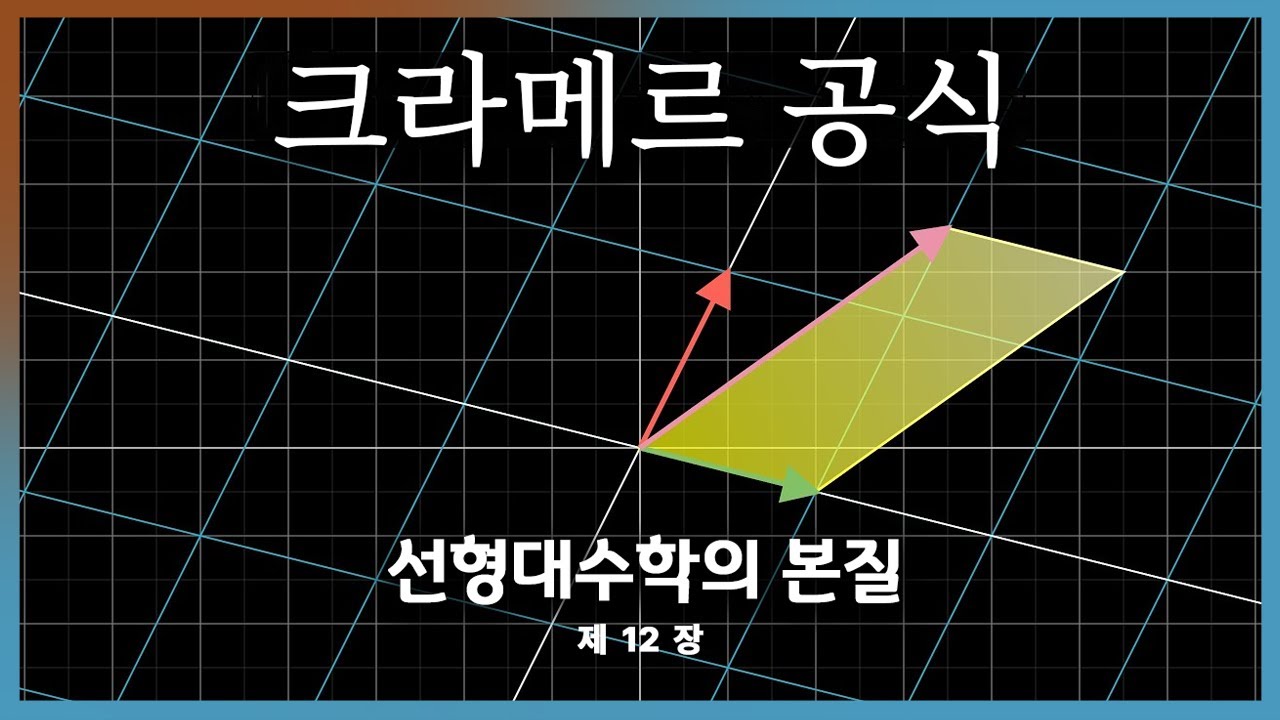
Chapter 12: A geometric interpretation of Cramer's rule | Essence of Linear Algebra
BeginnerKey Summary
- •This lesson explains Cramer's rule using geometry. A linear system like 2x + 5y = 7 and −3x + 4y = −1 can be written as Ax = v, where A’s columns are two vectors a1 and a2. The solution (x, y) tells how much to stretch and add a1 and a2 to land exactly on v.
- •Determinant as area is the key idea. In 2D, det(A) is the signed area of the parallelogram formed by a1 and a2. Replacing a column with v makes new parallelograms whose areas, when compared with det(A), give x and y.
- •Cramer’s rule says x = det(A_x)/det(A) and y = det(A_y)/det(A). A_x is A with its first column replaced by v; A_y is A with its second column replaced by v. These ratios measure how far along each column direction you must go to reach v.
- •Geometrically, solving Ax = v is like mixing two direction arrows to land at a target arrow. The numbers x and y are the mix amounts along those arrows. Determinants turn those geometric areas into simple fractions.
- •Using the example A = [[2, 5], [−3, 4]] and v = [7, −1], det(A) = 23. det(A_x) = 33 and det(A_y) = 19, so x = 33/23 and y = 19/23. Plugging back confirms both equations are satisfied.
- •If det(A) = 0, the area is zero, meaning the two column vectors lie on the same line. Then there isn’t a unique solution because you can’t form a full parallelogram. The system has either no solution or infinitely many.
- •The intersection-of-lines view matches the vector-mixing view. Each equation is a line; their intersection gives (x, y). The column interpretation says (x, y) are the exact scaling weights for a1 and a2 to make v.
- •
Why This Lecture Matters
A geometric grasp of Cramer’s rule is valuable for students, engineers, data analysts, and anyone who solves small systems. Many real-world problems—balances, mixes, and intersections—reduce to linear systems; seeing them as vector combinations makes solutions more intuitive. The determinant-as-area idea links abstract formulas to clear pictures, helping you spot mistakes and reason about signs, magnitudes, and uniqueness before doing any heavy algebra. This is especially helpful for teaching, quick problem solving, and building strong intuition for later topics like linear independence, bases, and transformations. In work and projects, a visual model speeds up sanity checks. For example, when modeling forces, prices, or flows with two factors, you can sketch column directions and predict whether the target is reachable and how large the coefficients should be. When det(A) is small, you’ll anticipate sensitivity and proceed with caution or redesign the system. While Gaussian elimination is the tool of choice for large systems, Cramer’s rule is excellent for exact 2×2 or 3×3 cases and for building the mental model needed to understand matrix inversion and eigenvalues later. Career-wise, mastering geometric interpretations sharpens problem-solving and communication. You can explain solutions to teammates or clients using shapes and areas, not just symbols. In today’s data-driven industry, this clarity is prized: it leads to fewer errors and faster decisions. Ultimately, the technology of determinants and linear systems is a cornerstone of computer graphics, robotics, physics simulations, and optimization—the geometric view is a powerful lens you can apply across them.
Lecture Summary
Tap terms for definitions01Overview
This lesson teaches a geometric way to understand Cramer’s rule, a method for solving small linear systems like two equations with two unknowns. The main idea is to move from a purely algebraic view—solving lines that intersect—to a vector and area view, where columns of a matrix form a parallelogram, and determinants measure its area. The system Ax = v can be seen as asking: how much of each column vector of A do we need to mix together to land at the target vector v? Cramer’s rule answers that using area ratios.
The lecture begins with a simple 2D system, 2x + 5y = 7 and −3x + 4y = −1. These equations represent two lines in the plane, and their intersection is the solution (x, y). Rewriting this in matrix form gives A = , x = ^T, and v = [7, −1]^T, so Ax = v. The columns of A, a1 = [2, −3]^T and a2 = [5, 4]^T, are vectors in the plane. The equation Ax = v is then the same as + = v, meaning v must be a linear combination—scaled sum—of these two column vectors.
The key geometric concept is the determinant. For a 2x2 matrix, its determinant is the signed area of the parallelogram spanned by the two column vectors. If we replace one column with the vector v to form a new matrix, say (replace the first column), A_x is the area of the parallelogram spanned by v and the remaining column. The ratios x = A_x/ and y = A_y/ tell precisely the scaling you need along each column to get v. This comes from how area scales with side length: doubling a side doubles area, so area ratios reveal length ratios along directions.
Who is this for? It targets beginners to intermediate learners of linear algebra who want intuition, not just formulas. You should know basic algebra, understand what a matrix and vector are, and be comfortable with solving two equations with two unknowns. No calculus or advanced proofs are required. A very light knowledge of determinants (as a 2x2 product difference ad − bc) helps, but this lesson gives the geometric meaning for deeper understanding.
After finishing, you will be able to interpret a linear system geometrically. You will relate Ax = v to the problem of mixing column vectors to hit a target. You will use determinants as area measures to compute Cramer’s rule in 2D and see how it generalizes to higher dimensions as volumes. You’ll also recognize when a unique solution exists ( ≠ 0) and when it does not ( = 0), and why those cases make sense geometrically.
The lesson is structured in a clear sequence: start with a concrete 2D example of two lines intersecting; rewrite the system in matrix form; interpret columns as direction vectors; define the determinant as the parallelogram’s area; construct and by swapping in v; and finally, interpret x and y as area ratios, giving Cramer’s formulas. The session closes by highlighting that this geometric perspective is not just a trick; it provides a visual, conceptual grasp of why the formulas work. With this, solving small systems isn’t only about plugging numbers but about seeing shapes, areas, and how vectors combine.
Key Takeaways
- ✓Always rewrite your system as Ax = v first. Identify the columns a1 and a2 because these are your direction arrows. This makes it clear you are searching for weights x and y that mix these arrows to land on v. The setup prevents confusion when forming A_x and A_y later.
- ✓Compute det(A) before anything else. If it is zero, stop using Cramer’s rule because a unique solution does not exist. Consider alternative methods to check for infinite or no solutions. This saves time and prevents dividing by zero.
- ✓Use the 2×2 shortcut ad − bc for all determinants. This reduces errors and speeds up computation. Keep track of signs carefully while multiplying. A single sign mistake flips your final answers.
- ✓Construct A_x and A_y correctly by replacing one column at a time. For A_x, replace the first column with v; for A_y, replace the second column with v. Do not swap rows or both columns at once. Verify you copied numbers accurately.
- ✓Interpret the ratios geometrically to check your work. If v is close to a2’s direction, expect |y| > |x|. If v is near a1, expect |x| > |y|. When your numbers don’t match the picture, recheck determinants.
- ✓Expect negative coefficients when v points opposite a column’s arrow. Negative means you move against that direction to reach v. This is normal and matches the signed area idea. Your diagram should show this by the relative orientation.
- ✓Sketch the columns and the parallelogram whenever you’re unsure. A quick drawing can reveal if your solution is reasonable. Seeing the shape helps detect arithmetic slips early. Visual checks complement numerical work.
Glossary
Linear system
A set of equations where each term is either a number or a number times a variable. In 2D, each equation draws a straight line on a graph. The solution is the point where all the lines meet at the same spot. If two lines are not parallel, they will meet once, giving one solution. If they are the same line, there are many solutions; if parallel and different, no solution.
Matrix
A rectangular grid of numbers arranged in rows and columns. It is like a table that organizes coefficients. Matrices can represent systems of equations or transformations that move and stretch space. A 2×2 matrix has two rows and two columns. Each column can be seen as a direction arrow (vector).
Vector
An ordered list of numbers that can represent a point or an arrow in space. It has direction and length. In 2D, a vector like [a, b] points a units along x and b units along y. Vectors can be added and scaled to make new vectors.
Ax = v
A compact way to write a linear system using a matrix A, an unknown vector x, and a known vector v. It says that when A acts on x, you get v. Interpreted by columns, it means a weighted sum of A’s columns equals v. The weights are the entries of x.