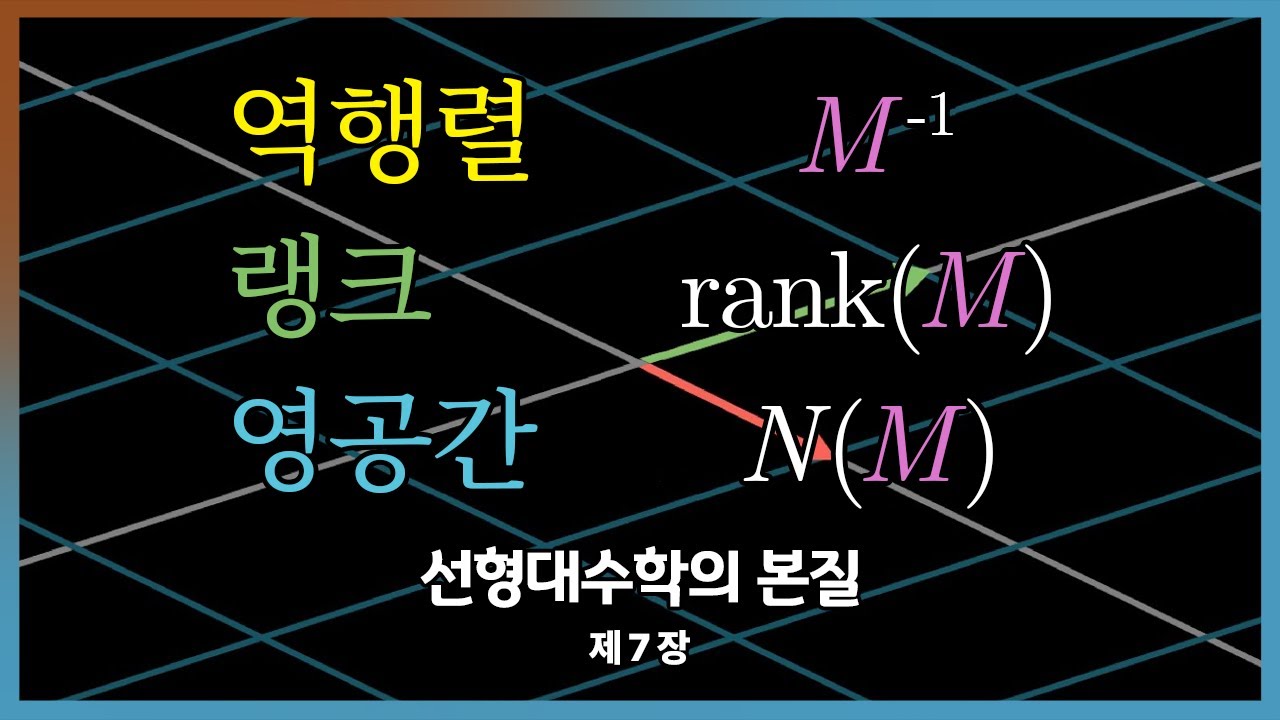
•Matrices represent linear transformations, which are rules that stretch, rotate, shear, or squash space while keeping straight lines straight and the origin fixed. When you multiply matrices, you are chaining these transformations: first do one change to space, then do the next. Some transformations lose information by collapsing dimensions, like flattening a whole plane onto a line, and those cannot be undone.
•An inverse matrix undoes what a matrix does. If A represents a transformation, A inverse (written A^{-1}) is the unique transformation that brings every vector back to where it started. Multiplying A by A^{-1} in either order gives the identity matrix I, which is the 'do nothing' transformation.
•A matrix is invertible only if it does not squash space into a lower dimension. Geometrically, this is captured by its determinant: if det(A) = 0, the transformation squashes some area or volume completely flat, so it cannot be reversed. If det(A) ≠ 0, an inverse can exist.
•To find an inverse in practice, set up the augmented matrix [A | I] and do Gaussian elimination (row operations) until the left side becomes I. The right side simultaneously becomes A^{-1}. This works because each row operation corresponds to multiplying by an elementary matrix that transforms A to I and thus transforms I to the sequence of operations that undo A.
•Simple scaling matrices invert by taking reciprocals of the scale factors. For example, A = [[3, 0], [0, 2]] scales the x-direction by 3 and the y-direction by 2, so A^{-1} = [[1/3, 0], [0, 1/2]]. This is the cleanest case of a diagonal matrix where inversion is straightforward.
•For a non-diagonal example A = [[1, 3], [-2, 0]], the columns show where the standard basis vectors i-hat and j-hat go: i-hat maps to (1, -2) and j-hat maps to (3, 0). Using [A | I] and row operations produces A^{-1} = [[0, -1/2], [1/3, 1/6]]. Checking A·A^{-1} yields the identity, confirming correctness.
Why This Lecture Matters
Inverse matrices, column space, and null space are the backbone of reasoning about linear systems in science, engineering, data, and graphics. If you understand when a transformation can be perfectly undone, you can guarantee unique solutions to equations like Ax = b and design stable algorithms. Column space tells you which outputs are even possible for a given system, guiding you when to expect solutions or when to adjust models. Null space reveals exactly what information is lost, which is critical in sensing, compression, and projections, as well as diagnosing why models fail to recover signals.
In practical work, these concepts explain the behavior of least-squares fitting, control systems, computer graphics transformations, and numerical solvers. Engineers rely on invertibility to ensure controllers can recover states; graphics programmers use inverses to reverse camera and object transforms; data scientists interpret rank to detect multicollinearity; and physicists check determinants to understand conservation or collapse of volume in phase space. Mastering Gaussian elimination and the augmented matrix method equips you to compute inverses cleanly and detect singularities early. Geometric intuition—columns as moved bases, determinants as scaling, column space as reachable outputs, and null space as lost directions—lets you predict outcomes quickly.
Career-wise, these skills are essential in linear modeling, machine learning foundations, and algorithm design. They underpin matrix factorizations, optimization, and numerical stability, which are common interview topics and daily tasks. In an industry where data problems are often framed as linear systems or transformations, fluency with invertibility, rank, and null space makes you faster, clearer, and more reliable at diagnosing and solving problems.
Lecture Summary
Tap terms for definitions
01Overview
This lesson develops three tightly connected ideas in linear algebra: inverse matrices, column space (image/range), and null space (kernel), all framed through the geometric viewpoint of linear transformations. A matrix represents a rule that reshapes space—stretching, rotating, shearing, or squashing—while keeping straight lines straight and the origin fixed. Matrix multiplication is simply doing one reshaping after another. The central question is: when can such a reshaping be perfectly undone? If a transformation loses information by crushing a dimension—like flattening an entire plane onto a single line—no amount of computation can retrieve the original positions. But if nothing is crushed, there is hope for a clean undo: an inverse matrix.
You learn the precise meaning of an inverse: for a matrix A, its inverse A−1 is the unique matrix such that A·A−1 = I and A−1·A = I, where I is the identity matrix, the transformation that does nothing. The lesson explains that determinants act like a geometric detector for invertibility: if det(A) = 0, area (in 2D) or volume (in 3D) collapses, implying a loss of dimension and no inverse; if det(A) ≠ 0, the transformation can be one-to-one and thus invertible. To go from definition to computation, you see the method to actually find A−1: form the augmented matrix [A | I], perform Gaussian elimination until the left side becomes I, and read off A−1 from the right. Intuitively, each row operation is itself a simple linear transformation that you are applying to A to step-by-step turn it into I. Applying those same steps to I collects exactly the combination that undoes A.
Next, the lesson reframes matrix outputs using column space. The columns of A show where the standard basis vectors land after the transformation. All possible outputs A⋅x are linear combinations of those columns, so the set of all outputs is the span of the columns, called the column space (also known as image or range). In 2D, if the two columns are not on the same line, their span covers the whole plane; if they lie on a single line, outputs are confined to that line; if both columns are zero, the only output is the origin. The dimension of this output space is rank. Full rank means the transformation reaches a full-dimensional space, and that is exactly the geometric condition that aligns with invertibility.
Finally, the lesson introduces the null space (kernel), which captures what gets lost. The null space consists of all input vectors v such that A⋅v = 0. If a transformation squashes the plane onto a line through the origin, everything along the perpendicular line collapses to the zero vector—that entire perpendicular line is the null space. When a matrix is invertible, the only vector that maps to zero is the zero vector itself; when it is not invertible, there are infinitely many nonzero vectors in the null space, which explains why information is lost and why you cannot recover unique inputs from outputs.
This lesson is aimed at beginners through early intermediates who have seen vectors and basic matrix multiplication and are ready to think geometrically about what matrices do. You should know how to multiply matrices and understand the idea of a linear combination. Some familiarity with Gaussian elimination is helpful but not strictly required; the lesson explains the augmented-matrix method for inverses and why it works.
By the end, you will be able to: decide if a matrix is invertible and explain why; compute an inverse using augmented matrices and row operations; interpret column space as the set of all possible outputs and identify its dimension as rank; and find or reason about the null space as the set of inputs that get crushed to zero. You will connect these ideas: invertibility ↔ determinant=0 ↔ full rank ↔ trivial null space. The structure of the lesson flows from intuition and geometry to algebra and computation: it starts with the big idea that some transformations cannot be undone, formalizes this with the identity and determinant, demonstrates the inverse-finding method, and then broadens the view by defining column space, rank, and null space. All examples are visual and concrete, like scaling matrices and a specific 2×2 matrix with computed inverse, and the squashing-to-a-line scenario that shows how null space appears.
Key Takeaways
✓Always test invertibility before trying to compute an inverse. For 2×2, check det ≠ 0; for larger matrices, start row-reduction and look for full pivots. If you hit a zero row you cannot fix by swapping, stop: the matrix is singular. Don’t waste time chasing an inverse that cannot exist.
✓Use the augmented matrix method as your go-to for hand-calculating inverses. Form [A | I], row-reduce to [I | A^{-1}], and verify by multiplication. This method generalizes to any size and doubles as an invertibility test. Keep arithmetic neat and pivot strategically to avoid errors.
✓Read columns as images of basis vectors to get instant geometric insight. The first column shows where i-hat goes; the second shows where j-hat goes. Sketching these quickly tells you if columns are colinear (rank 1) or spanning the plane (rank 2). Let geometry guide whether an inverse is plausible.
✓Remember the determinant’s geometric meaning to avoid abstract confusion. det = 0 means some dimension collapsed; det ≠ 0 means no collapse. This ties perfectly to invertibility without extra rules. Use it as a fast mental filter.
✓For diagonal matrices, invert by reciprocals—simple and reliable. Check that no diagonal entry is zero before inverting. This habit avoids divide-by-zero mistakes. It also reinforces intuition about per-axis scaling and undoing.
✓Avoid computing inverses to solve Ax = b in real projects. Instead, use elimination or factorization (LU/QR) for better numerical stability. Reserve explicit A^{-1} only when you truly need the inverse operator itself. This practice reduces error and improves performance.
✓
Glossary
Linear transformation
A rule that stretches, rotates, shears, or squashes space while keeping straight lines straight and the origin fixed. It turns inputs into outputs in a way that respects adding and scaling vectors. Every matrix represents such a rule. Thinking of matrices as transformations makes geometry and algebra line up. You can picture how a grid changes shape to understand the math.
Matrix multiplication
A way to combine two transformations into one by applying them in sequence. The product AB means first apply B to a vector and then apply A. It is not the same as multiplying numbers; order matters. The columns of AB equal A times each column of B. This matches the idea of moving basis vectors step by step.
Inverse matrix (A^{-1})
A matrix that undoes the action of another matrix A. It satisfies A·A^{-1} = I and A^{-1}·A = I. It exists only if no information is lost by A. If it exists, it is unique. Inverses are like perfect rewind buttons.
Identity matrix (I)
The 'do nothing' matrix with 1s on the main diagonal and 0s elsewhere. Multiplying by I leaves any vector or matrix unchanged. It acts like the number 1 for matrices. It anchors the definition of inverses. Seeing I in products means the undo worked perfectly.
Version: 1
•The column space of a matrix is the set of all outputs the matrix can produce, also called its image or range. It is the span (all linear combinations) of the matrix’s columns. In 2D, if the columns are not on the same line, the column space is the whole plane; if the columns lie on one line, the column space is that line; if the columns are zero, the column space is just the origin.
•Rank is the dimension (size) of the column space. In a 2×2 matrix, rank can be 0 (only the origin), 1 (a line), or 2 (the whole plane). Full rank (rank 2 in 2D, rank n in nD) means no dimension was lost, which is exactly the condition needed for invertibility.
•The null space (also called the kernel) is the set of all input vectors that map to the zero vector when multiplied by A. It captures the directions that get completely flattened. For example, if a transformation squashes the plane onto a line, then every vector along the perpendicular line maps to zero and is in the null space.
•Invertibility, determinant ≠ 0, full rank, and a trivial null space ({0} only) all go together. If any one fails—like a zero determinant—others fail too: you lose full rank, gain a nonzero null space, and cannot build an inverse. This bundle of equivalent conditions helps you quickly assess a matrix.
•Gaussian elimination uses row operations (swap rows, scale a row, add a multiple of one row to another) to systematically simplify matrices. When applied to [A | I], it reveals not only whether A is invertible (you can reach I on the left) but also computes A^{-1} on the right. Conceptually, you are constructing the exact sequence of moves that undoes A.
•Thinking geometrically helps: columns tell you where basis vectors land, the determinant tells you whether area/volume is preserved or crushed, the column space tells you the possible outputs, and the null space tells you what information is lost. Together they explain when and how a transformation can be reversed. These ideas are core to solving systems, analyzing data, and designing algorithms.
02Key Concepts
01
Inverse Matrix (What it is): An inverse matrix A−1 undoes the action of a matrix A so that A·A−1 = I and A−1·A = I, where I is the identity. Think of it like an exact rewind button for a transformation of space. If you first stretch, rotate, or shear space with A, then applying A−1 puts every point back where it started. This only makes sense if no information was lost during A’s action. If an inverse exists, it is unique, and we call A invertible.
02
Identity Matrix (Why it matters): The identity matrix I is the 'do nothing' transformation that leaves every vector unchanged. Multiplying any matrix or vector by I returns the same matrix or vector, so it acts as a neutral element. Invertibility is defined relative to I: both A·A−1 and A−1·A must equal I, not just be close. Because I has 1s on the main diagonal and 0s elsewhere, it encodes the idea that each basis direction stays put. Seeing I appear in computations is your confirmation that an exact undo has been achieved.
03
Geometric Non-Invertibility (Squashing): Some transformations collapse space into a lower dimension, like flattening a 2D sheet into a 1D line or a 3D block into a 2D plane. Once this crushing happens, multiple different points end up at the same place, making it impossible to tell where they came from. This many-to-one effect means no unique inverse can exist. Any matrix that performs such a squash is non-invertible. The geometric signature of this collapse is a zero determinant.
04
Determinant as Invertibility Test: The determinant measures how a matrix scales area (in 2D) or volume (in 3D). If det(A) = 0, the area or volume collapses to zero along some direction, signaling loss of dimension and no inverse. If det(A) ≠ 0, the transformation preserves a nonzero scale, so it can be one-to-one and thus invertible. Determinants connect geometry and algebra: they give a fast test for invertibility without computing an inverse. They also relate to the linear independence of columns.
05
Simple Inverse: Diagonal Matrices: For A = (3002), the x-direction scales by 3 and the y-direction by 2. To undo it, scale back by the reciprocals: A−1 = (1/3001/2). Diagonal matrices are easy because each axis acts independently. This shows how inverses directly reflect the original action on the basis directions. It's the cleanest illustration of the undo idea.
06
Columns as Images of Basis Vectors: The columns of A show where the standard basis vectors i-hat and j-hat land after the transformation. For A = (1−230), the first column (1, -2) is where i-hat goes, and the second column (3, 0) is where j-hat goes. Any output A⋅x is a weighted mix (linear combination) of these columns. Reading columns as moved basis vectors gives an immediate geometric picture of the transformation. This view underlies the idea of the column space.
07
Augmented Matrix Method for A−1: To find A−1, form [A | I] and perform row operations until the left side becomes I. The right side will end up as A−1. Each row operation is a valid linear transformation applied to both sides that keeps the equality true. If you cannot reach I on the left (you hit a zero row), A is not invertible. This method both tests invertibility and computes the inverse when it exists.
08
Why the Augmented Method Works: Row operations correspond to multiplying by elementary matrices that encode simple, reversible steps. A sequence of such steps transforms A into I, meaning their product is A−1. Applying these same steps to I composes them into exactly A−1. Thus [A | I] → [I | A−1] is not a trick but a direct construction of the undoing transformation. This also explains why the method fails exactly when A is non-invertible.
09
Worked Inverse Example (Non-Diagonal): For A = (1−230), start with [A | I] = (1−23∣10∣001). Add 2 times row 1 to row 2, scale row 2, and eliminate the 3 in row 1 to get [I | (01/3−1/21/6)]. Checking A·A−1 = I confirms correctness. This example shows inverses do not require memorized formulas—systematic row operations suffice. It illustrates how off-diagonal mixing of axes is cleanly undone.
10
Column Space (Image/Range): The column space of A is the set of all vectors you can get as A⋅x for some x. Algebraically, it’s the span of A’s columns—the set of all linear combinations of those columns. In 2D, if columns are not colinear, their span is the whole plane (rank 2); if colinear, the span is a line (rank 1); if zero, it’s just the origin (rank 0). Column space captures the transformation’s reach: what outputs are even possible. It is central for understanding solvability of Ax = b, though that is beyond this lesson’s main focus.
11
Rank: Rank is the dimension of the column space. It counts how many independent directions the columns provide. Full rank (n for an n×n matrix) means no collapse of dimension, which matches invertibility. Reduced rank means the outputs are confined to a lower-dimensional space. Rank can be found via row reduction by counting pivot columns.
12
Null Space (Kernel): The null space is the set of all vectors v with A⋅v = 0. It describes the directions that get completely flattened to the origin by the transformation. If a map squashes the plane onto a line, the perpendicular line is the null space because all those vectors vanish to zero. An invertible matrix has only the zero vector in its null space. A non-invertible matrix has a nontrivial null space with infinitely many vectors.
13
Equivalences for Invertibility: For a square matrix A, the following go together: A is invertible; det(A) ≠ 0; A has full rank; its columns are linearly independent; its null space is only {0}. If any one fails, others fail too. This web of equivalences lets you pick the easiest test for your situation. Geometrically, they all mean no directions were crushed. Algebraically, they ensure a unique undo exists.
14
Row Operations and Reversibility: The three basic row operations—swap rows, scale a row by a nonzero number, add a multiple of one row to another—are all reversible. That’s why Gaussian elimination can be used to build inverses: each step can be undone. If you ever need to retrace your steps, you just reverse the sequence. This reversibility is the backbone of the [A | I] method. Hitting a non-reversible situation (like needing to divide by zero) signals non-invertibility.
15
Geometric Intuition as a Guide: Thinking in pictures—where bases go, what areas do, which directions flatten—makes abstract algebra concrete. Columns are moved basis vectors; determinant is area/volume scaling; column space is the reachable set; null space is the lost-information set. These mental images explain not only what to compute but why it works. They also predict behavior before you calculate. This intuition prevents blind symbol pushing.
16
Projections and Null Space: A projection onto a line through the origin keeps only the component of vectors along that line. Everything perpendicular to that line maps to zero, so the perpendicular direction is the null space. This gives a crisp example where the column space is that line and the null space is its perpendicular. Projections have determinant zero and are not invertible. They are canonical examples of dimension loss.
17
Shears and Rotations as Invertible Maps: A shear (like (1011)) and a rotation preserve area (determinant±1) and do not crush dimension. They are invertible, with inverses that 'unshear' or rotate back. This shows that off-diagonal mixing or spinning does not by itself kill invertibility. What matters is whether any area or volume is sent to zero. Purely geometric changes that keep dimensions intact remain reversible.
18
Why Not Always Use A−1 to Solve Ax = b?: Although inverses are conceptually clean, computing A−1 explicitly is often unnecessary and can be numerically unstable. Gaussian elimination can solve Ax = b directly without forming A−1. Still, knowing when an inverse exists and what it means is essential. The inverse frames the condition for unique solutions and the idea of undoing transformations. It also helps reason about chains of transformations via matrix multiplication.
03Technical Details
Overall Architecture/Structure of Ideas
Linear transformations and matrix multiplication
A matrix A represents a linear transformation T: Rn → Rm that preserves straight lines and the origin. Applying A to a vector x gives T(x) = A⋅x, which is a linear combination of the columns of A weighted by the components of x. If x = x1x2...xn^T and A has columns a1, a2, ..., an, then A⋅x = x1 a1 + x2 a2 + ... + xn an.
Matrix multiplication AB corresponds to composing transformations: first apply B, then apply A. The columns of AB are A times the columns of B, showing how basis directions move step by step.
Some transformations are injective (one-to-one) and preserve dimension; others are many-to-one and squash dimensions. Only injective, dimension-preserving transformations can have inverses.
Inverse matrices: definition and properties
Definition: A−1 is a matrix such that A·A−1 = I and A−1·A = I. For square matrices, if a left-inverse exists and a right-inverse exists, they are equal and unique.
Existence: Not every square matrix has an inverse. Invertibility requires full rank: rank(A) = n for an n×n matrix. Equivalently, columns must be linearly independent; equivalently, determinant must be nonzero.
Uniqueness: If A⋅B = I and A⋅C = I, then B = C by multiplying appropriately and using associativity. Thus the inverse, when it exists, is unique.
Interpretation: A−1 is the exact undo of A. In geometry, if A scales, rotates, and shears, A−1 unscales, rotates back, and unshears in the correct order.
Determinant and dimension collapse
In 2D, det(A) equals the signed area scaling factor of the unit square after transformation by A. If det(A) = 2, areas double; if det(A) = 1/2, areas halve; if det(A) = 0, areas collapse to zero—meaning some directions are flattened.
In 3D, det(A) equals the signed volume scaling factor of the unit cube after applying A. det(A) = 0 means the cube becomes flat (volume zero), indicating image lies in a lower-dimensional subspace.
det(A) ≠ 0 ensures columns are linearly independent and span a full-dimensional space; det(A) = 0 implies columns are dependent and the column space is lower-dimensional. Therefore, det(A) ≠ 0 is necessary (and for square matrices sufficient) for invertibility.
Computing inverses: methods and reasoning
Diagonal matrices: A = diag(d1, d2, ..., dn) is inverted by reciprocating diagonal entries: A−1 = diag(1/d1, ..., 1/dn), provided no di = 0.
Augmented matrix method (Gaussian elimination): Form [A | I]. Use row operations—(i) swap two rows; (ii) scale a row by a nonzero scalar; (iii) replace a row by itself plus a multiple of another row—to reduce A to I. Apply the same operations to the identity on the right; the result becomes A−1. If you cannot get I on the left (you get a zero row), A has no inverse.
Why it works formally: Each row operation is multiplication on the left by an elementary matrix E. A sequence of operations Ek ... E2E1 transforms A into I, so Ek ... E2E1 = A−1. Applying the same product to I yields A−1 explicitly.
2×2 formula (optional computational shortcut): For A = (acbd), if ad − bc=0, then A−1 = (1/(ad − bc)) (d−c−ba). This formula follows from solving A⋅X = I or from adjugate/cofactor theory. Although handy, the augmented method generalizes better.
Worked inverse example: A = (1−230)
Start with [A | I] = (1−23∣10∣001).
Row 2 ← Row 2 + 2⋅Row 1: (103∣16∣201).
Row 2 ← (1/6)⋅Row 2: (103∣11∣1/301/6).
Row 1 ← Row 1 − 3⋅Row 2: (100∣01∣1/3−1/21/6).
Now left side is I, so A−1 is the right block: (01/3−1/21/6). Verify A·A−1 = I and A−1·A = I by multiplication.
Column space (image/range)
Definition: Col(A) = {A⋅x : x ∈ Rn} = span{a1, a2, ..., an}, where ai are columns of A. It is the set of all outputs the transformation can produce.
Geometric read-off: The first column is where i-hat (1, 0, ..., 0)^T goes; the second column is where j-hat goes; etc. All outputs are combinations of these destinations.
Examples in 2D: If columns are not multiples, their span is all of R2 (rank 2). If columns are multiples (colinear), their span is a 1D line through the origin (rank 1). If both columns are zero, span is just {0} (rank 0).
Practical finding: Reduce A to row-echelon form; pivot columns (in the original A) identify a basis for the column space. Alternatively, inspect if one column is a scalar multiple of the other in 2D.
Rank
Definition: rank(A) = dimension of Col(A). Equivalently, rank is the number of pivot columns after row reduction.
Full rank vs. reduced rank: For n×n, full rank n means invertible; reduced rank < n means non-invertible. Rank reflects how many independent directions survive the transformation.
Relation to determinant: det(A) ≠ 0 iff rank(A) = n for square matrices. det(A) = 0 iff rank(A) < n.
Relation to null space (see next): In general, rank + nullity = number of columns (n) for an m×n matrix, reflecting a balance between retained and lost dimensions.
Null space (kernel)
Definition: Null(A) = {v ∈ Rn : A⋅v = 0}. It consists of all inputs that the transformation crushes to the zero vector.
Geometric examples: Projection onto a line L through the origin has Null(A) = L^⊥ (the perpendicular direction). In 2D, projecting onto the x-axis with A = (1000) yields Null(A) = the y-axis, since any (0, y) maps to (0, 0).
Invertibility connection: A is invertible iff Null(A) = {0}. Any nonzero vector in Null(A) signals many-to-one behavior and loss of information.
Finding null space: Solve A⋅x = 0 via row reduction. Free variables (if any) parametrize the null space directions.
Step-by-Step Implementation Guide (conceptual and computational)
Step 1: Decide if A might be invertible
Quick tests: Check det(A) (for square matrices); if zero, not invertible. Or start row-reducing A; if you reach a zero row (no pivot in some column), not invertible. In 2D, see if columns are colinear; if so, not invertible.
Geometric scan: Ask, does any direction look flattened? If yes, expect det 0 and no inverse.
Step 2: If invertible, compute A−1
Form [A | I]. Perform Gaussian elimination until the left block is I. Keep arithmetic precise; avoid dividing by zero (if needed pivot is zero, swap rows).
Record operations conceptually: each step builds the sequence that undoes A. The final right block is A−1.
Verify (optional but recommended): Multiply A·A−1 and A−1·A to confirm identity.
Step 3: Understand column space and rank
Identify columns a1, a2, ..., an. Determine if they are independent (none is a combination of the others). In 2D, test if one is a scalar multiple of the other; in higher dimensions, reduce to row-echelon form and count pivots.
The dimension of Col(A) is rank(A). A full-rank square matrix is a good sign you can invert; rank deficiency indicates constraints on outputs.
Step 4: Find or reason about the null space
Solve A⋅x = 0 via row reduction. Express solutions in terms of free variables to form a basis for Null(A).
Interpret geometrically: the null directions are exactly those that vanish under A. In 2D projection onto a line, the null space is the perpendicular line.
Tools/Libraries Used
No programming libraries are required for these concepts; everything is analytic. However, standard computational tools like NumPy (numpy.linalg.inv, numpy.linalg.det, numpy.linalg.matrixrank) implement these ideas. Symbolic tools (like SymPy) can perform exact Gaussian elimination and compute null spaces.
If coding: ensure square matrices for inverses; use robust solvers (e.g., solve Ax = b with solve or least squares rather than forming A−1 explicitly) to reduce numerical error.
Tips and Warnings
Don’t compute inverses unless necessary: For solving Ax = b, use elimination or factorization methods (LU, QR) instead of forming A−1. Forming A−1 can amplify numerical errors.
Pivoting matters: When doing elimination, if a pivot is zero or tiny, swap rows to avoid division by very small numbers (partial pivoting improves stability).
Watch for det 0: If det(A) = 0 or you encounter a zero pivot you cannot fix with row swaps, the matrix is singular (non-invertible). Stop trying to compute A−1 and instead analyze column space and null space.
Geometric sanity checks: If columns are colinear in 2D, rank is 1; if one column is zero, rank at most 1; if both zero, rank 0. For invertible 2×2, columns must not be multiples.
Verify inverses: Always check both products A·A−1 and A−1·A equal I if doing hand calculations. A single arithmetic slip can ruin the result.
Putting It All Together
Invertibility is the algebraic name for being able to perfectly undo a transformation. Determinant, rank, column space, and null space are the geometric and algebraic diagnostics that tell you whether such an undo exists.
The augmented matrix method builds the inverse constructively using reversible steps. Column space describes the entire menu of outputs; rank measures how large that menu is. Null space captures the parts of inputs that become invisible (lost) to the transformation, explaining exactly why some matrices are non-invertible.
With these tools, you can decide when a map is reversible, compute its undo, and understand the shape of both its outputs and its information loss.
04Examples
💡
Diagonal Scaling Inverse: Input A = (3002), which stretches x by 3 and y by 2. To undo, scale x by 1/3 and y by 1/2, giving A−1 = (1/3001/2). Applying A then A−1 returns any vector (x, y) to itself. This illustrates the simplest inverse: take reciprocals of the diagonal scales.
💡
Non-Diagonal Inverse via Augmentation: Given A = (1−230), form [A | I] and row-reduce to [I | (01/3−1/21/6)]. Multiplying A by this right block yields the identity, confirming it's A−1. The process uses adding multiples of rows and scaling rows to isolate pivots. It showcases that inverses can be found without memorizing formulas.
💡
Squashing Plane to a Line (Non-Invertible): Consider a transformation that maps all of R2 onto the x-axis, like A = (1000). Any vector (x, y) maps to (x, 0), so different inputs with the same x collapse to the same output. The determinant is 0, rank is 1, and the null space is all vectors of the form (0, y). Because many inputs map to one output, there is no inverse.
💡
Column Space as Outputs: For A = (2346), the columns (2, 3) and (4, 6) are colinear, since the second is 2 times the first. The column space is the line spanned by (2, 3). Any output is some multiple of (2, 3), so the matrix can only reach points on that line. Rank is 1, signaling dimension loss.
💡
Zero Matrix Extreme: With A = (0000), every input maps to (0, 0). The column space is just the origin, so rank is 0. The null space is all of R2, since every vector goes to zero. This is the most collapsed transformation possible.
💡
Shear is Invertible: Let A = (1011). This slants the plane but does not collapse area: det(A) = 1. The inverse is (10−11), which unshears the plane. This shows that mixing axes does not necessarily destroy invertibility.
💡
Rotation is Invertible: A rotation matrix R(θ) preserves lengths and areas with det(R) = 1. The inverse is R(−θ), which rotates back. No direction is crushed, so the null space is trivial ({0}). The column space is the entire plane, and rank is 2.
💡
Reading Columns as Moved Bases: For A = (1−230), the first column (1, −2) is the image of i-hat and the second column (3, 0) is the image of j-hat. Any output A·(ab)^T equals a⋅(1, −2) + b⋅(3, 0). This means all outputs lie in the span of those two columns. Since they’re not colinear, the span is the full plane.
💡
Determinant Zero Signals Dependence: Take A = (1224). The determinant is 1⋅4 − 2⋅2 = 0, and the columns are dependent (second is twice the first). The column space is a line; rank is 1; non-invertible. This example ties the determinant test directly to the geometry of columns lining up.
💡
Null Space of a Projection: Project onto the x-axis with A = (1000). Then A⋅(0, 5) = (0, 0), so (0, 5) is in the null space; in fact, the entire y-axis is Null(A). The column space is the x-axis, the set of all reachable outputs. This shows how column space and null space are perpendicular lines in this case.
💡
Augmented Matrix Failure Detects Non-Invertibility: Try to invert A = (1224) using [A | I]. Row reduction leads to a zero row on the left, so you cannot reach I. The process halts, signaling A is singular. This computationally confirms what determinant and column dependence already told you.
💡
Verifying an Inverse by Multiplication: For A = (1−230) and A−1 = (01/3−1/21/6), compute A·A−1. The first column becomes [10 + 3(1/3), −20 + 0(1/3)] = (1, 0), and the second column becomes [1*(−1/2) + 3*(1/6), −2*(−1/2) + 0*(1/6)] = (0, 1). The product is I, verifying correctness. This check is a good habit after hand calculations.
💡
Rank by Pivot Counting: For A = (1326), reduce to row-echelon form: Row 2 ← Row 2 − 3⋅Row 1 gives (1020). There is one pivot, so rank(A) = 1. The column space is a line, and the null space is 1-dimensional. This method scales to larger matrices.
💡
Trivial Null Space for Invertible Matrices: For A = (3002), solve A⋅x = 0. Only x = (0, 0) works, so Null(A) = {0}. This aligns with det(A) = 6=0 and rank 2. All invertibility indicators agree.
💡
Connecting Outputs to Inputs via Column Space: Suppose b is not on the line spanned by A’s columns when rank is 1. Then there is no x with A⋅x = b, because b is not in the column space. If b is in the column space, there are infinitely many inputs mapping to b (due to a nontrivial null space). This shows how column space and null space together control solvability and uniqueness.
05Conclusion
This lesson built a coherent picture of when and how a linear transformation can be undone. Starting from the geometric idea that some matrices crush dimensions—like flattening a plane to a line—it established that such dimension loss destroys invertibility. The identity matrix anchors the definition of an inverse: A−1 must undo A in both orders, producing the do-nothing transformation I. Determinant provided a powerful geometric-algebraic test: nonzero means no collapse and the potential for an inverse; zero means a collapse and no inverse. The augmented matrix method then gave a concrete, systematic way to compute inverses by tracking the exact row operations that reverse A.
The discussion of column space and rank reframed outputs: all possible outputs form the span of the columns, and the dimension of that span is rank. Full rank in a square matrix aligns perfectly with invertibility, while reduced rank signals constrained outputs and the presence of lost directions. Null space completed the picture by identifying precisely what gets lost: all inputs that end up at zero. In an invertible map, the null space is trivial; in a non-invertible map, it is a whole direction (or more) of space.
To practice, compute the inverse of several 2×2 matrices using the augmented method, verify with multiplication, and compare to the 2×2 formula. For column space and rank, take random 2×2 examples and decide whether the columns are colinear; if they are, find the line they span and identify rank 1; if not, identify rank 2. For null space, analyze projection matrices and find the perpendicular direction that vanishes. As a mini-project, build a small script to row-reduce [A | I] and report A−1, rank, and a basis for the null space.
Next steps include studying row-reduced echelon form in depth, exploring the full set of equivalences in the Invertible Matrix Theorem, and learning the rank–nullity relationship more formally. You can also examine how these ideas determine the existence and uniqueness of solutions to Ax = b, and later connect to eigenvalues and eigenvectors, where determinants and invertibility take on new meanings. The core message to remember is that linear algebra is clearest when seen geometrically: columns are moved basis vectors, determinants measure space-scaling, column space is the reachable set, and null space is the lost-information set. With these mental models, you can predict and explain matrix behavior long before finishing the calculations.
Diagnose rank visually in 2D by checking if columns are multiples. If they are, rank is 1 and there’s no inverse; if not, rank is 2 and inversion is possible. In higher dimensions, rely on row-reduction and pivot counting. Rank tells you the size of the reachable output space.
✓Use null space to understand information loss. Solve A·x = 0 to find directions that vanish; those form Null(A). If Null(A) has nonzero vectors, expect many-to-one mapping and no unique inverse. This explains why some problems cannot be uniquely solved.
✓Verify inverses both ways to catch slips: compute A·A^{-1} and A^{-1}·A. Small arithmetic mistakes can hide if you only check one product. Seeing the identity both times confirms correctness. In practice, numerical checks should tolerate slight floating errors.
✓Treat row operations as reversible steps to build confidence in elimination. Each swap, scale, or row addition has a clear inverse move. This reversibility guarantees the logic behind [A | I] and elimination-based solving. Understanding it reduces memorization.
✓Use projections as clear examples of non-invertibility. Identify the target subspace as the column space and the perpendicular as the null space. Recognize that det = 0 because dimension drops. These examples cement intuition for rank and null space.
✓Connect the core equivalences: invertible ↔ det ≠ 0 ↔ full rank ↔ independent columns ↔ trivial null space. Memorize this cluster rather than isolated facts. It forms a quick diagnostic checklist for any square matrix. Applying it saves time and prevents errors.
✓Practice by hand with small matrices to cement skills. Compute inverses with augmentation, find column space and rank, and solve A·x = 0 for null space. Verifying each with geometric sketches deepens understanding. Repetition builds speed and accuracy.
✓Use geometry to sanity-check algebraic results. If you find rank 2 in 2D but your columns look colinear, recheck your arithmetic. If det is reported zero but columns are clearly independent, verify calculations. Let pictures and numbers cross-validate each other.
Determinant
A single number that measures how a matrix scales area (2D) or volume (3D). If it’s zero, the matrix collapses space into a lower dimension, making it non-invertible. If it’s nonzero, the transformation keeps volume nonzero and may be invertible. The sign can show orientation flips. It ties geometry to algebra.
Gaussian elimination
A step-by-step method using row operations to simplify a matrix. It helps solve systems, find inverses, and compute rank. The key moves are swapping rows, scaling a row, and adding multiples of rows. Each move is reversible. It’s like tidying a messy table into a neat pattern.
Row operation
A basic change to a matrix row: swap two rows, multiply a row by a nonzero number, or add a multiple of one row to another. These operations are reversible and preserve solutions to Ax = b when applied correctly. They are the building blocks of elimination. Each has a matching elementary matrix. They never change the column space dimension if done to both sides of an equation.
Augmented matrix [A | I]
A single block matrix that places A next to an identity matrix I. As you row-reduce, you apply the same operations to both blocks. If A reduces to I, the right block becomes A^{-1}. If not, A is not invertible. It’s a compact way to compute inverses.