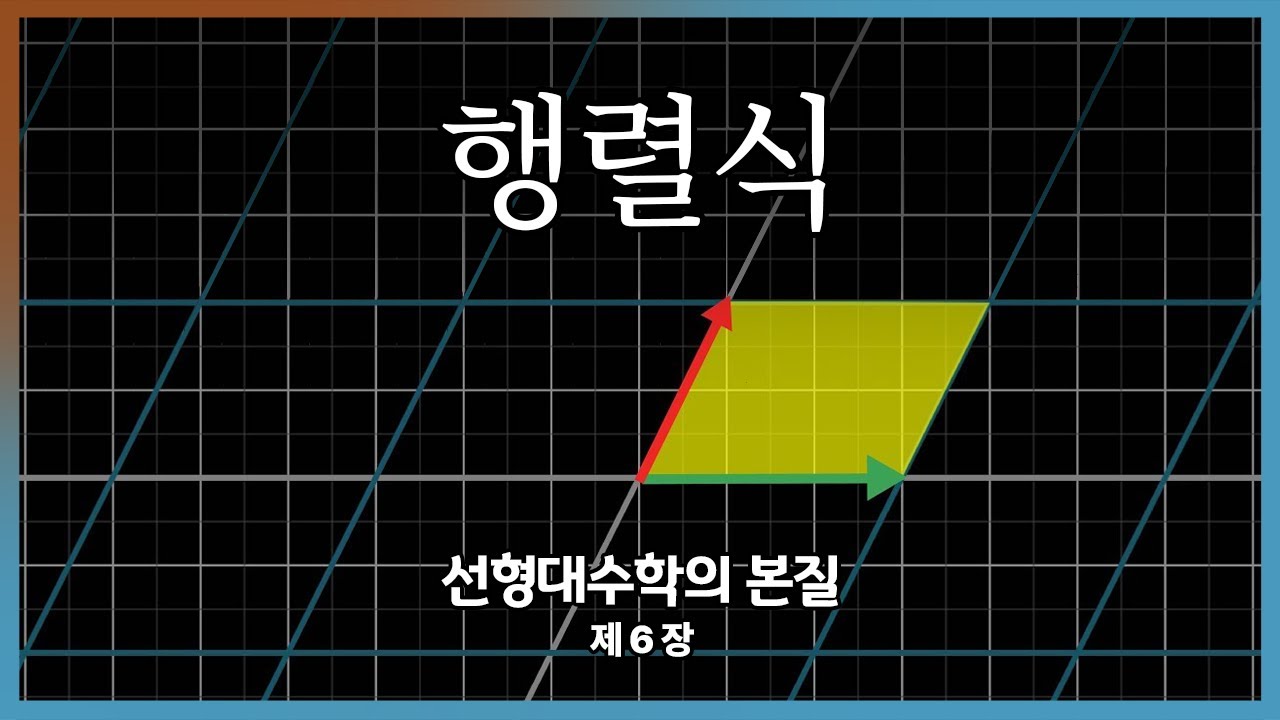
Chapter 6: The determinant | Essence of Linear Algebra
BeginnerKey Summary
- •The determinant is a single number attached to every square matrix that tells how a linear transformation scales area in 2D or volume in 3D. Its absolute value is the scale factor, and its sign tells whether the transformation keeps orientation or flips it. Think of dropping a 1-by-1 square (or 1-by-1-by-1 cube) into the transformation and measuring what size it becomes.
- •In 2D, the determinant of a matrix with columns [a, c] and [b, d] equals ad − bc. This number is the signed area of the parallelogram made by the images of the standard basis arrows i-hat and j-hat. Large a and d stretch mainly along their original axes, while large b and c shear, slanting i-hat and j-hat toward each other.
- •A positive determinant means the transformation keeps orientation (the order of i-hat then j-hat stays counterclockwise). A negative determinant means it flips orientation, like a mirror reflection that turns right-handed order into left-handed order. The size of the determinant still gives the area change.
- •In 3D, the determinant measures how a unit cube’s volume changes under the transformation. A determinant of 8 means every small volume becomes 8 times bigger; −8 means the same size change but with a handedness flip (right-hand system becomes left-hand).
- •Determinants multiply under composition: det(AB) = det(A) × det(B). If A doubles area and B triples area, doing A then B multiplies areas by 6 overall. This rule matches how we expect scaling to stack.
- •A determinant of 0 means the transformation squashes space into a lower dimension. In 2D, everything is flattened onto a line, so area becomes 0; in 3D, space may flatten into a plane, so volume becomes 0. This also means the matrix is not invertible.
- •
Why This Lecture Matters
Understanding determinants through geometry helps students, engineers, data scientists, and developers reason about matrices without heavy algebra. It quickly answers practical questions: Does a matrix collapse space (det = 0)? Does it keep or flip orientation (sign of det)? By seeing the determinant as an area/volume scale, you can predict behavior in graphics pipelines, coordinate changes, simulation steps, and robotics transformations. This knowledge solves recurring problems: checking invertibility before attempting to solve linear systems, estimating how much a transformation magnifies errors or noise, and understanding why certain pipelines lose information. In real projects, you often compose many transformations; knowing det(AB) = det(A)det(B) lets you track the overall scale instantly. In optimization and physics, similar ideas appear in change of variables and volume preservation, where determinants say how densities or volumes evolve. Career-wise, a strong geometric feel for determinants builds confidence to tackle advanced topics. It supports later work in multivariable calculus (Jacobians), computer graphics (transform stacks), machine learning (feature transforms), and control systems (state-space models). In today’s industry, where data and geometry meet often, this mental model is a lasting tool: it speeds up debugging, improves design choices, and makes math less about memorizing and more about understanding.
Lecture Summary
Tap terms for definitions01Overview
This lesson builds a clear, picture-first understanding of the determinant, a single number defined for every square matrix. The central idea is simple: view a matrix as a linear transformation, which is a rule that moves vectors in a straight, grid-respecting way. Then, watch what happens to a unit shape under that transformation—a 1-by-1 square in 2D or a 1-by-1-by-1 cube in 3D. The determinant tells you how much the transformation stretches or shrinks that shape and whether it flips its orientation, like switching from a right-hand to a left-hand system.
Starting in 2D, the determinant measures the signed area scaling of the unit square. If i-hat (the standard unit vector along x) moves to some new vector, and j-hat (the standard unit vector along y) moves to another vector, these two images form a parallelogram. The area of that parallelogram, with a sign that indicates orientation, is the determinant. For a matrix with columns and , the determinant equals ad − bc. This compact formula matches the picture: it is the signed area of the parallelogram formed by those two column vectors.
The sign of the determinant matters. A positive sign means orientation is preserved—the order of i-hat then j-hat still goes counterclockwise. A negative sign means the order is flipped, like a mirror image, so the system’s “handedness” changes. The absolute value of the determinant gives the scale factor for area in 2D (or volume in 3D). For example, a transformation that stretches x by 3 and y by 2 has determinant 6, because the unit square becomes a rectangle with area 6.
In 3D, the same idea holds, now with volume. The determinant tells how a unit cube’s volume changes. For example, stretching x, y, and z each by 2 multiplies volume by 8, so the determinant is 8. If one axis is also flipped, the determinant becomes −8, showing that handedness is reversed while the size scaling is the same.
A powerful property ties everything together: determinants multiply under composition. If matrix A doubles area and matrix B triples it, doing A then B multiplies area by 6 overall. This is the statement = × . This rule matches our intuition about stacking transformations and gives a quick way to reason about how complicated combinations scale space.
Another crucial case is when the determinant equals zero. Geometrically, this means space collapses into a lower dimension. In 2D, all points get pushed onto a line, making any area zero; in 3D, space might flatten into a plane, making any volume zero. A zero determinant signals that the transformation loses information and cannot be reversed. It also foreshadows the link to solving linear systems: zero determinant means no unique solution.
Who is this for? The lesson is aimed at beginners and anyone who prefers intuition before formulas. You should know what matrices and vectors are, what matrix multiplication does (it composes transformations), and recognize the standard basis vectors i-hat, j-hat, and k-hat. No heavy algebra is required, because the focus is on understanding via pictures and simple examples.
After finishing, you will be able to: describe the determinant as a signed area or volume scale; decide whether a transformation keeps or flips orientation; quickly estimate a determinant’s sign and magnitude by visualizing where the basis vectors go; explain why determinants multiply under composition; and recognize that a zero determinant means dimension collapse and no inverse. These skills help in real tasks like checking if a matrix is invertible, understanding shape changes in graphics, and anticipating solution behavior in linear systems.
The lesson’s flow moves from simple to general. First, it defines the determinant in 2D using the unit square and the parallelogram made by the images of i-hat and j-hat. Next, it shows the formula ad − bc and explains how diagonal stretching versus shearing affect the number. Then, it explores the sign as a marker of orientation and shows examples, including reflections. The idea is extended to 3D with unit cubes and handedness. Finally, it presents the multiplicative rule = \operatorname{det}(A)$$\operatorname{det}(B) and explains the meaning of a zero determinant as collapse to a lower dimension. The closing note sets up a future link to how determinants relate to solving systems of linear equations.
Key Takeaways
- ✓Always read the columns first: they show where i-hat, j-hat, k-hat go. Sketch them from the origin to see the new grid cell. Decide if they spread out (big magnitude), nearly align (small or zero), or flip order (negative sign). This fast picture often replaces long calculations.
- ✓Separate magnitude and sign in your mind. The absolute value of det is size scaling; the sign tells orientation. Never say “negative area” or “negative volume”—the negative sign means a flip, not negative size. This separation avoids common interpretation errors.
- ✓Use ad − bc for 2×2 matrices as a quick check. Before computing, guess the result by visualizing the two column vectors. Then confirm with the formula to catch mistakes. If the vectors nearly line up, expect a small number or zero.
- ✓Diagonal and triangular matrices are your shortcuts. For these, the determinant is the product of diagonal entries. Use them as sanity checks and to build confidence in the scaling picture. They match the idea that axis stretches multiply.
- ✓Remember: transformations don’t need to preserve shape to preserve area. Shears can slant a square into a parallelogram with the same area. Don’t confuse shape change with size change. The determinant tracks only size and orientation.
- ✓Composition multiplies determinants—plan with that in mind. If you know the scale of each step, you know the total scale. If any step has determinant zero, the whole chain collapses. This rule helps manage complex pipelines of transformations.
- ✓Use determinant sign to detect reflections and odd flips. If the determinant is negative, some flip happened. If it’s positive, no net flip happened. Combine this with magnitude to get the full story of a transformation.
Glossary
Determinant
A single number for a square matrix that tells how the matrix scales area (in 2D) or volume (in 3D) and whether it flips orientation. The absolute value gives the scale; the sign tells if the order of directions is kept or reversed. It is found by looking at what happens to a unit square or unit cube. Positive means orientation is kept; negative means it is flipped. Zero means space is squashed into a lower dimension.
Square matrix
A matrix with the same number of rows and columns (like 2×2 or 3×3). Only square matrices have determinants. They represent linear transformations from a space to itself (like 2D to 2D). This makes size change and orientation comparisons possible. Non-square matrices do not have determinants.
Linear transformation
A rule that moves vectors so that straight lines stay straight and the grid stays evenly spaced. It respects scaling and adding: T(u + v) = T(u) + T(v) and T(cu) = cT(u). Matrices represent these transformations. They change shapes by stretching, shrinking, shearing, rotating, or reflecting. Determinants measure the size and orientation effects of these changes.
i-hat (unit x vector)
A short arrow pointing one unit along the x-axis, written as (1, 0) in 2D or (1, 0, 0) in 3D. It is a basic building block to describe directions. Matrices tell us where i-hat moves, which helps us see how the whole space moves. Its new position is the first column of the matrix.